A plumbing company in town had a steady stream of calls for years. Then one quarter the phone went quiet. The owner had not changed a thing, but a competitor two miles away had crept into the top three map results for "emergency plumber near me." By the time anyone noticed, three months of leads had walked out the door.
This story plays out for service businesses everywhere. Local search shifts every few months because Google updates its features, competitors add reviews, and customer search habits change with the seasons. Reacting only after the phone stops ringing means the damage is already done.
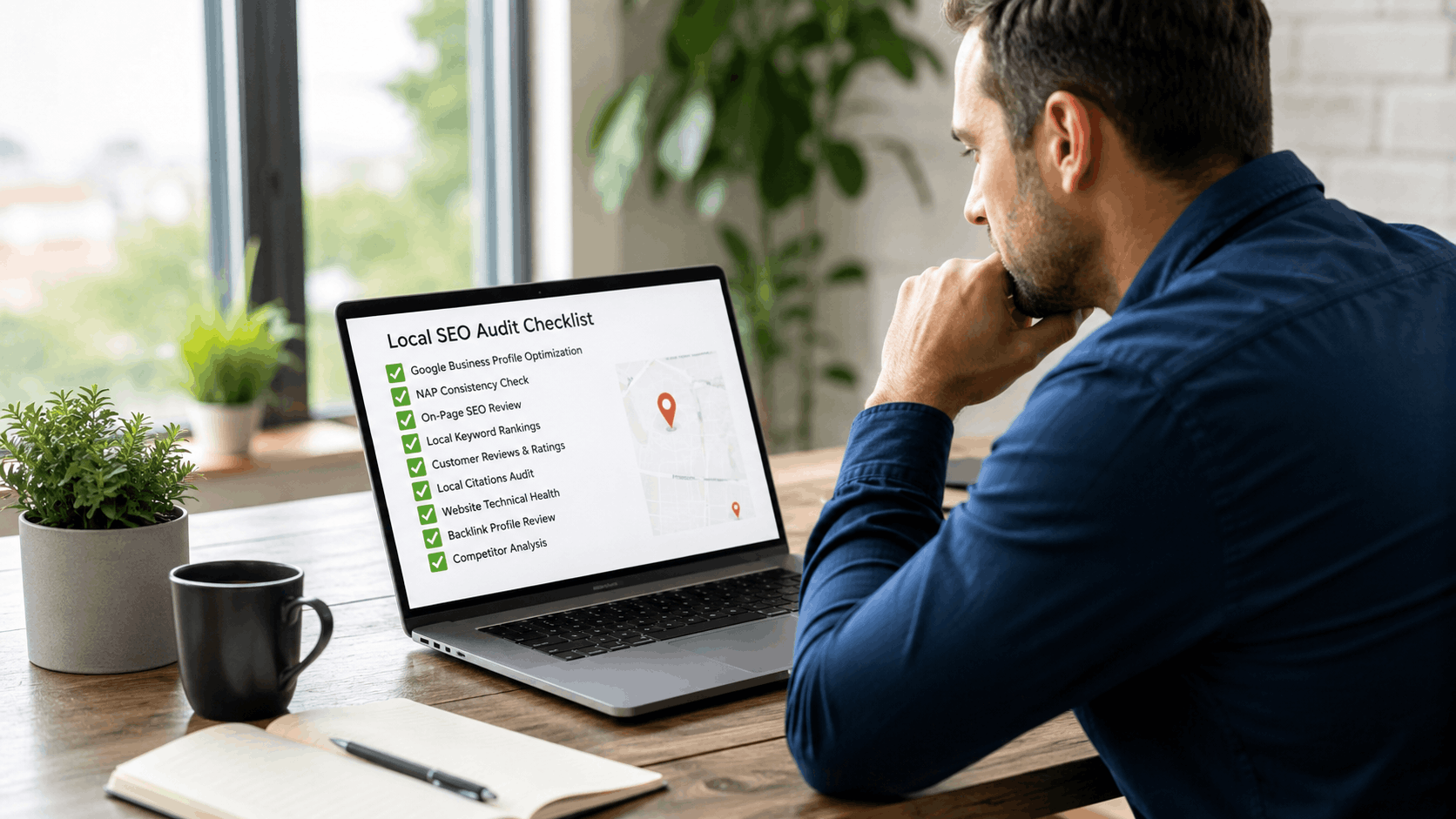
A set schedule beats firefighting. That is why The Local SEO Audit Checklist Every Service Business Should Run Quarterly exists as a repeatable routine any owner can follow. Run it four times a year and you catch small slips before they cost real money. The sections below walk through each part in order, so anyone can sit down and work through it.

- 01Start Your Local SEO Audit With Your Google Business Profile
- 02Run a Grid-Based Local Rank Tracking Check
- 03Audit Your Citations and NAP Consistency
- 04Review Your Online Reviews and Reputation Signals
- 05Inspect Your Website for Local SEO Health
- 06Analyze Your Competitors' Local SEO
- 07Audit Your Local Link Building and Outreach
- 08Turn Your Audit Into a Quarterly Action Plan
- 09Final Thoughts
- 10Frequently Asked Questions About Local SEO Audits
Start Your Local SEO Audit With Your Google Business Profile
The Google Business Profile is the single most important local listing a service business owns. It feeds the map pack, fills in the knowledge panel, and often makes the first impression before someone ever clicks to the website. A Google Business Profile audit should always come first because a problem here drags down everything else.
Google changes profile features often, sometimes adding buttons, sometimes quietly removing fields. A field that worked last quarter might be gone or moved this quarter. That is why GBP optimization is never a one-time task. Below is a quick local listing check standard to grade each item pass or fail.
| Item | Pass standard |
| Primary category | Matches the main service exactly |
| Hours | Current, with holiday hours set |
| Photos | At least 3 new in the last 90 days |
| Reviews replied to | 90 percent or more answered |
| NAP | Matches the website word for word |
Verify Your Categories, Services, and Business Description
The primary business category tells Google what the business does more than any other setting. A drain cleaning company set to "Plumber" instead of "Drainage service" can lose ranking for its main jobs. Confirm the primary category matches the main service in plain terms first.
Secondary GBP categories add reach without hurting the main one. A roofer might add "Gutter cleaning service" and "Siding contractor" to catch related searches. Add every category that honestly fits the work the team actually performs.
The services list inside the profile is easy to forget. An outdated list that still mentions a service the business dropped, or skips a new one, costs jobs every week. Review each service line and rewrite the description so it names the main work and the city served.
The business description should read like a person wrote it, not a keyword dump. Mention the main services and the areas covered in clear sentences. Google does not weight this heavily, but customers read it before they call.
Check Your Hours, Service Area, and Contact Details
Hours seem simple until a holiday rolls around. A business marked open on Memorial Day when the crew is off frustrates callers and trains Google to distrust the listing. Set holiday hours a quarter ahead so GBP hours accuracy stays clean.
For a service area business that travels to customers, the service area radius matters more than the pin. Set it too wide and Google spreads the listing thin across zones the team rarely visits. Set it too narrow and nearby searchers never see the business at all.
List the specific towns and neighborhoods served rather than one giant circle. A landscaper covering the east side should name those suburbs so Google connects the listing to those searches. Review this list every quarter as the service area grows or shrinks.
The phone number Google displays should be the one the team actually answers, not an old tracking line or a disconnected cell. Confirm it matches the number on the website. A wrong number sends paying customers to a dead end.
Review Photos, Posts, and Product Listings
Fresh GBP photos signal an active business to Google and to people deciding whom to call. A profile with the same five photos from three years ago looks abandoned. Add at least three new photos each quarter showing real work, the team, and finished jobs.
Google Business posts work like a small feed on the profile. Post once a week if possible, or at minimum every two weeks, with a seasonal offer, a job photo, or a quick tip. A steady cadence tells Google the listing is maintained.
Photos should show the work the business wants to rank for. A bathroom remodeler should post before and after shots of actual bathrooms, not stock images. Geotag photos when the tool allows and name files with the service and area.
Product listings and service highlights round out the profile. Even service businesses can list packages or named services with short descriptions and starting prices. A refresh schedule of once a quarter keeps these from going stale.
Scan for Suggested Edits and Spam Listings
Anyone can submit GBP suggested edits to a business profile, and Google sometimes accepts them without warning. A competitor or a random user could change the hours, address, or even the category. Check the profile every quarter to confirm nothing was altered behind the owner's back.
Log into the profile and review every field against the approved version. If a suggested edit slipped through, revert it right away and document the correct details. Catching this early prevents weeks of wrong information showing in search.
Spam and fake listings steal local visibility from honest businesses. A competitor might create a listing with keyword-stuffed names like "Best Cheap Plumber City" to outrank real companies. Learn to report spam listings through Google's redressal form so the map pack stays fair.
Google publishes guidelines on what counts as a violation. The Google Business Profile guidelines spell out which practices break the rules. Reference them when filing a report so the claim sticks.
Run a Grid-Based Local Rank Tracking Check
A single rank check from one spot tells a misleading story. Standing in the office and searching shows the business ranking number one, but a customer three miles away might never see it. Grid rank tracking fixes this blind spot.
A local rank tracker that uses a grid shows how map pack rankings change block by block across a city. Owners see exactly where they are strong and where they vanish. Here is why grid tracking beats a single search:
- It reveals weak zones the office search hides
- It maps competition that varies by neighborhood
- It shows the real reach of the service area
- It tracks progress in spots that matter for revenue
Map Your Rankings Across Different Neighborhoods
Rankings often stay strong near the physical address and drop fast a few miles out. Google ties map results to distance, so a business downtown may dominate downtown searches and disappear in the outer suburbs. A geo-grid ranking view makes this pattern obvious.
Reading a grid is straightforward once it is set up. Green dots mean top spots, yellow means middle pages, red means invisible. A wall of red on the north side tells the owner exactly where to focus next.
Neighborhood rankings guide where to spend effort. If a plumber gets plenty of calls from one district but none from a growing subdivision two towns over, the grid shows whether the problem is ranking or simply demand. The Rank Map feature plots this across a full grid so weak zones stand out.
Knowing the weak spots lets owners plan content and outreach by area. A page built around an underserved neighborhood, plus a few local links from that area, can turn red dots green over a quarter. Without the grid, that work would be guesswork.
Track the Keywords That Actually Drive Calls
Vanity keywords feel good but rarely ring the phone. Ranking number one for "plumbing" means little next to ranking for "water heater repair [city]." Local keyword tracking should center on service-plus-city terms customers really type.
Start by listing the exact phrases customers use when they call. They say "my drain is backed up" or "need an emergency electrician," not industry jargon. Match those phrases to tracked keywords so the data reflects real demand.
High-intent keywords carry buying signals. Terms with words like "repair," "near me," "emergency," or "cost" mean someone is ready to hire. Prioritize tracking these over broad informational searches that rarely convert.
Sort the keyword list by how many calls each term likely drives, then track the top fifteen to twenty. A short focused list beats a sprawling one nobody reviews. Revisit the list each quarter as service offerings and seasons shift.
Compare This Quarter to Last Quarter
A single grid snapshot is a photo; a series is a movie. Save the grid every quarter so rank tracking trends become visible over time. Without saved snapshots, an owner cannot tell whether last quarter's work moved the needle.
A quarterly ranking comparison answers the question that matters: did anything help? Lay this quarter's grid next to last quarter's and look for zones that improved. Green spreading into formerly red areas means the plan worked.
Reading the trend also flags problems early. If a neighborhood that was green slips to yellow, something changed - maybe a competitor added reviews or a suggested edit hurt the profile. Catching the dip early gives time to respond.
Keep a short log next to each snapshot noting what changed that quarter. New location page, a batch of fresh reviews, a holiday hours fix. Tying actions to results teaches which moves pay off for this specific business.

Audit Your Citations and NAP Consistency
Mismatched name, address, and phone details across directories confuse Google. If one site lists a suite number and another drops it, or an old phone number lingers somewhere, the search engine trusts the business less. NAP consistency is the quiet foundation of local ranking.
A citation audit finds these mismatches across the dozens of directories where a business appears. Some listings get created without the owner ever knowing. Walking through them every quarter keeps local directory listings clean and aligned.
Find Duplicate and Conflicting Listings
Old listings from past addresses or phone numbers linger online for years. A business that moved across town in 2020 may still have a 2018 address floating on three directories. These duplicate listings split ranking signals and send customers to the wrong place.
Start by searching the business name plus the city, then the old phone number, then the old address. Each search surfaces stray listings. Write down every one found, noting which detail is wrong on each.
Conflicting NAP data does more damage than a single typo. Two listings with different phone numbers tell Google the business cannot keep its own facts straight. Track each conflict and decide whether to merge, claim, or remove it.
Some directories let owners merge duplicates directly; others require a support request. Work through the list methodically, fixing the highest-traffic directories first. A free scan in the Local Snapshot tool can surface many of these in one pass.
Prioritize Industry and Local Directories
Not every directory carries the same weight. For service trades, general sites like Google, Bing, and Apple Maps matter most, followed by trusted local citations. Spending hours on obscure directories nobody reads wastes the quarter.
Industry directories add real value for specific trades. A contractor benefits from Houzz and Angi; an HVAC company from manufacturer locator pages. List the two or three niche directories that matter for the trade and confirm the listing is accurate on each.
Local sources punch above their weight. The chamber of commerce, trade association pages, and city business listings give both a citation and a credibility signal. These often come with a link too, which helps beyond NAP alone.
Build a short master list of the directories that matter for this business and revisit it each quarter. Twenty solid, accurate listings beat a hundred sloppy ones. Quality of placement matters more than raw count.
Standardize Your Business Name and Format
Pick one approved format for the business name and use it everywhere. Decide whether it is "Smith Plumbing LLC" or "Smith Plumbing" and never mix the two. Business name consistency removes the small differences that add up to distrust.
Address formatting needs the same discipline. Choose how suite numbers appear - "Ste 200" or "Suite 200" or "#200" - and apply it on every listing. Google reads these as the same place more reliably when they match exactly.
Phone style deserves a single standard too. Pick one format and keep it identical across the website, GBP, and every directory. Even a different area of formatting can register as a different number to some systems.
Write this approved format into a one-page document the whole team uses. Anyone creating a new listing copies from that sheet. A single source of truth prevents new inconsistencies from creeping in between audits.
See where you rank - block by block.
Vouch Local maps your local rankings across every neighborhood and shows you exactly who wins each area. Start free, no credit card required.
Review Your Online Reviews and Reputation Signals
Reviews drive both trust and ranking. A review audit checks review count, star average, and response rate across Google and other sites. These reputation signals influence whether a business lands in the map pack and whether searchers click to call.
Steady new reviews carry more weight than a big pile of old ones. Google reviews ranking rewards businesses that keep collecting feedback month after month. The targets below give a sense of what steady looks like for most service businesses.
Measure Review Velocity and Recency
Review velocity is the pace of new reviews coming in. A business with two hundred reviews but none in the last six months looks stalled. One with forty reviews and three new ones each month looks alive and active.
Google leans on recent reviews to judge whether a business is currently operating well. Three reviews from last week outweigh thirty from two years ago in the eyes of both the algorithm and the customer. Recency keeps the profile feeling current.
A reasonable monthly review target for most service businesses sits between four and ten new reviews. A busy plumber doing dozens of jobs a month should aim higher; a niche specialist with fewer clients can aim lower. The point is a steady, honest flow.
Build a simple system to ask every satisfied customer for a review the same day the job finishes. A text with a direct link works better than a verbal request. Tracking how many asks turn into reviews shows whether the system needs tuning.
Audit Your Responses to Positive and Negative Reviews
Replying to reviews is its own ranking and trust signal. Responses that naturally mention the service and city name help reinforce what the business does and where. A reply like "Glad we fixed the water heater for you in Riverside" reads naturally and reminds Google of the relevance.
Aim to answer at least 90 percent of reviews, and reply within a day or two. Fast, genuine responses show prospects that the business pays attention. A profile full of unanswered reviews suggests the owner has checked out.
Negative reviews need a calm, steady hand. Thank the person, acknowledge the issue, and offer to make it right offline. A defensive or angry reply does more damage than the original complaint ever could.
Keep a short reply template for both good and bad reviews so responses stay quick and consistent. Customize each one with a real detail from the job. A template gives structure; the personal touch keeps it human.
Check Reviews on Secondary Platforms
Google is not the only place customers and Google itself look. Yelp reviews, Facebook recommendations, and trade-specific review sites all factor into reputation. Many searchers cross-check a business on two or three sites before calling.
Audit these third-party review sites each quarter for new reviews and overall rating. A great Google rating paired with a neglected Yelp page full of old complaints sends mixed signals. Respond on the secondary sites the same way as on Google.
Keep the same business identity across every platform. The name, logo, and contact details should match what is on Google and the website. A mismatched profile on Facebook can confuse both customers and search engines.
Decide which secondary platforms matter for the trade and focus there. A restaurant cares about Yelp; an HVAC company might care more about Angi or BBB. Spreading thin across every site nobody uses wastes effort better spent on Google.

Inspect Your Website for Local SEO Health
The website tells Google where a business works and what it does. On-page local SEO covers location pages, schema, speed, and mobile usability. A website SEO audit each quarter catches the technical slips that quietly cost rankings.
Many of these items make a clean checklist an owner can hand straight to a developer. Below the surface, local landing pages and structured data do heavy lifting. Walk through each piece in order.
Audit Your Location and Service Pages
Dedicated pages for each city and service capture more searches than a single catch-all page. A page titled "Water Heater Repair in Maple Grove" can rank for that exact search where a generic services page cannot. Build location pages for the towns that actually drive revenue.
Thin, copy-pasted pages do more harm than good. Google spots fifteen near-identical city pages with only the town name swapped and ignores most of them. Each page needs unique content - local landmarks, neighborhood details, real job examples.
Service pages SEO works the same way. One strong page per main service, written for the searcher, beats a single page that lists everything in a cramped list. Each service page should answer common questions and name the areas served.
Review every location and service page each quarter for freshness and uniqueness. Update old prices, add recent project photos, and confirm the content still reads like a person wrote it for that specific place. Stale pages slowly lose ground to fresher competitors.
Check Local Business Schema Markup
Local business schema is structured data that feeds Google the address, hours, and review details in a format it reads cleanly. Proper markup helps the search engine display the right information and trust it more. Most service sites either lack it or have errors in it.
The markup should include the business name, address, phone, hours, and service area at minimum. When it matches the GBP and the visible page content, it reinforces every other signal. A mismatch between schema and the rest of the site causes confusion.
Test the markup with a free validator before assuming it works. Google's structured data documentation and its Rich Results Test show whether the code is present and error-free. Run this every quarter since site updates can break existing markup.
If errors show up, hand the report to a developer with the specific lines flagged. Fixing schema is usually a quick job once someone knows what is broken. Clean structured data is one of the cheaper wins in a local audit.
Test Page Speed and Mobile Experience
Most local searches happen on phones, often from someone standing in a driveway with a leaking pipe. A slow page or a layout that breaks on mobile loses that customer in seconds. Page speed and mobile usability are not optional for service businesses.
Aim for a page that loads in under three seconds on a phone over a normal connection. Large unoptimized images are the most common culprit for slow service sites. Compressing photos alone often shaves a second or two off load time.
Test the mobile experience by actually using the site on a phone. Can a thumb tap the call button easily? Does text need pinching to read? These small frictions cost calls even when rankings are fine.
Free tools like Google PageSpeed Insights grade both speed and mobile friendliness. Run the homepage and the top location pages each quarter. Hand the developer a short list of the worst offenders rather than a vague "make it faster."
Verify Title Tags and Internal Links
Title tags are the clickable headlines in search results and a strong ranking signal. Write them with the service and city terms that match how people search - "Emergency Plumber in Cedar Park | Smith Plumbing." A vague title like "Home" wastes the most valuable text on the page.
Every important page needs a unique title tag. Duplicate titles across location pages confuse Google about which to rank. Audit the titles each quarter and rewrite any that are missing, duplicated, or off-target.
Internal linking ties the site together so Google understands its structure. Link service pages to the relevant city pages and back to the homepage with descriptive anchor text. A page with no internal links pointing to it looks unimportant to the search engine.
Map out the main pages and confirm each one links to and from related pages. The location pages should connect to the services offered there. This linking also helps visitors find what they need faster, which keeps them on the site.
Analyze Your Competitors' Local SEO
The businesses ranking above you in the map pack hold the answers. Competitor analysis studies what they do better - their links, reviews, and content. Turning that study into a short action list closes the gap faster than guessing.
Pick the three or four local SEO competitors who consistently outrank the business in the grid. Look at the same factors for each. The Scout feature pulls competitor data into one view so the comparison takes minutes instead of hours.
Compare Backlink Profiles
Backlinks from local sites still move local rankings. Competitor backlinks show which community pages, news sites, and directories point to the businesses on top. Finding those same sources lets a business earn links of its own.
Run a link analysis on each top competitor to list their referring sites. Look past the big national directories to the local ones - a town newspaper, a youth sports league, a regional blog. These local links are the ones worth chasing.
Many competitor links come from places any business could get into. A sponsorship, a guest article, a local award page. Sort the list by which links seem reachable and which require deep relationships.
Build a short target list of five to ten link sources to pursue this quarter. The Competitor Links feature surfaces these gaps automatically. Chasing the right links beats chasing every link.
Spot Content Gaps You Can Fill
Competitors often cover service questions and topics a business skips. Content gap analysis finds those missing pages and posts. Each gap is a search the business is not answering and a competitor is.
List the service questions customers ask - "how much does a sump pump cost," "signs of a slab leak" - and check which competitors answer them. The ones the business has not covered become a content backlog. The Content Gaps feature compares topic coverage across competitors.
Turn each gap into a planned page or post. A page answering a common question can rank and pull in searchers at the research stage. Some of those readers turn into callers when they are ready to hire.
Prioritize local content ideas by search demand and buying intent. A topic that combines a real question with a city name and a service ranks and converts. Write a few of these each quarter rather than trying to cover everything at once.
Benchmark Their Reviews and Profiles
Competitor reviews tell where the bar sits. If the top three businesses all have over a hundred reviews and a 4.8 average, a business with thirty reviews has a clear gap to close. Profile benchmarking puts the goal in plain numbers.
Compare review counts, star averages, and how recently each competitor earned reviews. A competitor pulling ten new reviews a month is widening the gap every quarter. Matching or beating that pace becomes a concrete target.
Look at their profile habits too - categories, posting frequency, photo counts. Sometimes a competitor wins simply because they post weekly and the business posts never. Small efforts like this often close the gap.
Pick one or two areas where the business trails most and focus there this quarter. Maybe it is review velocity, maybe it is posting cadence. Benchmarking turns a vague "they beat us" into a fixable list.

See where you rank - block by block.
Vouch Local maps your local rankings across every neighborhood and shows you exactly who wins each area. Start free, no credit card required.
Audit Your Local Link Building and Outreach
Links pointing to a site still shape how Google ranks it locally. A backlink audit reviews where those links come from and how good they are. Local link building from community sites carries more weight than random links from anywhere.
A quarterly outreach routine keeps links growing instead of stalling after a one-time push. Local outreach to community sites and partners compounds over time. The pieces below build that routine.
Review Your Current Backlink Quality
Not every link helps. Backlink quality separates the useful local links from low-value or spammy ones. A link from the chamber of commerce helps; a link from a foreign spam directory can hurt.
Pull the full list of sites linking to the business and sort by quality. Look at whether each site is real, local, and relevant. Most service businesses have a mix of solid links and junk picked up over the years.
Spammy links sometimes need disavowing. Google's disavow tool tells the search engine to ignore specific links that drag the site down. Use it carefully and only for clearly toxic links, since disavowing good links by mistake causes harm.
Document the link profile each quarter so changes are easy to spot. A sudden batch of new spam links could signal a negative attack worth addressing. Tracking the baseline makes the unusual easy to catch.
Find Local Sponsorship and Partnership Links
Community events, sports teams, and local nonprofits often link to the businesses that sponsor them. A youth soccer league's sponsor page, a food bank's donor list, a festival's partner section - each gives a genuine local link. Sponsorship links double as good community work.
Look around the actual community for these chances. A local 5K, a school fundraiser, a neighborhood cleanup. Sponsoring something the business genuinely supports earns a link and goodwill at the same time.
Partnerships with complementary businesses also create community backlinks. A plumber and a remodeler who refer each other might link from their respective sites. These relationships feel natural because they are.
Keep a running list of sponsorship and partnership chances to pursue each quarter. Even one or two genuine local links per quarter add up over a year. Quality and relevance beat volume here too.
Set Up an Automated Outreach Routine
Outreach falls apart when it depends on remembering to do it. An automated outreach routine builds a repeatable system to reach local sites and partners every quarter. Automation keeps the effort steady without eating hours each week.
Build a list of target sites, a few message templates, and a schedule. Automation handles the sending and follow-ups while a person handles the actual relationships. The Email Assistant feature drafts and sends these so the link outreach system runs in the background.
Track responses and links earned so the routine improves over time. Which message got replies? Which sites said yes? Refine the templates and the target list based on what works.
A steady link outreach system beats sporadic bursts. Three or four genuine outreach attempts a month, run on autopilot, build a link profile that grows quarter after quarter. Consistency is what compounds.
Turn Your Audit Into a Quarterly Action Plan
An audit produces a pile of findings. Without a plan, that pile sits and nothing changes. A local SEO action plan sorts the findings into a short, ranked to-do list so the work actually gets done.
The goal is to keep the process from becoming overwhelming. SEO task prioritization decides what to fix first, what to schedule, and how to track results before the next audit. A clear quarterly SEO plan turns notes into progress.
Rank Fixes by Impact and Effort
Sort every finding into a simple grid of impact and effort. High-impact, low-effort tasks are the quick wins to do first. Fixing a wrong phone number or claiming a duplicate listing takes minutes and can move rankings fast.
SEO quick wins build momentum and free up calls quickly. Knock these out in the first week or two after the audit. The fast results also make the bigger projects easier to justify.
Bigger projects - building new location pages, a content backlog, a link campaign - get scheduled across the quarter. Task prioritization means tackling the changes that move rankings fastest before the slow-burn work. Map each task to its expected payoff.
Avoid trying to fix everything at once. A focused list of the top ten items beats a list of fifty that never gets touched. Finish the quick wins, then chip away at the larger items week by week.
Assign Owners and Deadlines
A task with no owner and no due date never gets done. Give every item on the list a specific person and a deadline. SEO task management is mostly about accountability.
Split work between internal staff and outside help based on skill. The office manager can handle review requests and GBP posts; a developer handles schema and speed fixes. Match each task to whoever can do it well.
Write the assignments where everyone can see them. The Tasks feature tracks who owns what and when it is due. A shared list keeps work from slipping through the cracks.
Check progress weekly rather than waiting until the next audit. A quick fifteen-minute review keeps tasks moving. Small steady progress beats a frantic scramble the week before the next quarter starts.
Set Up Tracking for the Next Audit
Baseline the metrics now so next quarter shows clear progress. Record the current grid rankings, review count, star average, and number of citations. SEO tracking only works when there is a starting point to compare against.
Log the same numbers every audit so the comparison stays consistent. A performance baseline this quarter becomes the benchmark next quarter. Without it, improvement is just a feeling instead of a fact.
Pick a handful of numbers that matter most and track them religiously. Grid ranking averages, monthly review count, call volume, and link count cover the basics. The Dashboard feature keeps these in one place across quarters.
Save everything in the same format each time. A simple spreadsheet or a dashboard works as long as it is consistent. The next audit becomes faster and clearer when the baseline is already there.
See where you rank - block by block.
Vouch Local maps your local rankings across every neighborhood and shows you exactly who wins each area. Start free, no credit card required.
Final Thoughts
Local search moves whether a business watches it or not. Running this audit four times a year catches the small slips before they become quiet months with no calls. The routine matters more than any single fix.
Start with the Google Business Profile, work through the grid, citations, reviews, website, competitors, and links, then turn it all into a ranked plan. Each quarter builds on the last. Over a year, the compounding effect shows up in the map pack and on the phone.
A platform like Vouch Local pulls these pieces into one place so the audit takes less time each quarter. The work still matters most, but the right tools make it repeatable.
Frequently Asked Questions About Local SEO Audits
How often should a service business run a local SEO audit?
A full audit every quarter fits most service businesses well. It is often enough to catch shifts before they cost real leads, but not so often that it becomes a burden.
Some pieces deserve a monthly check. Reviews, GBP posts, and suggested edits change fast enough that a quick monthly look pays off. The deep audit stays quarterly.
Businesses in fierce markets or those recovering from a ranking drop may benefit from monthly mini-audits. Track the basics monthly and run the full checklist every three months.
How long does a full local SEO audit take?
By hand, a thorough audit takes most owners four to eight hours spread across a few days. The citation check and competitor research eat the most time when done manually.
With software, the same audit drops to one or two hours. Grid tracking, citation scans, and competitor data that took hours to gather appear in minutes. The time saved is the main reason tools exist.
The first audit always takes longest because there is no baseline. Later quarters go faster since most of the setup is already done and you are mostly comparing to last time.
Can I run a local SEO audit myself or do I need an agency?
Most owners can handle a DIY SEO audit with a checklist and a few tools. Reviewing the GBP, checking reviews, and updating pages take time but not deep expertise. The checklist in this article walks through each step.
Outside help pays off for the technical pieces. Schema markup, site speed fixes, and serious link campaigns often go faster with a developer or an agency. Owners can do the audit and hand the hard fixes to a specialist.
The middle path works for many. Run the audit in-house to know exactly what is wrong, then hire help only for the items that need it. That keeps costs down and keeps the owner informed.
What tools do I need for a local SEO audit?
Three types of tools cover most needs. A grid-based local rank tracker for map pack position, a citation tool for NAP consistency, and a competitor research tool for links and content gaps.
Free tools handle some of the work. Google PageSpeed Insights checks speed, the Rich Results Test checks schema, and Google Search Console shows traffic. These cover the technical basics.
An all-in-one platform combines rank tracking, citations, and competitor data so the audit happens in one place. The tools page lists what each one does. Fewer tabs means a faster audit.
How long until I see results after fixing audit issues?
Quick fixes like correcting NAP errors or claiming a duplicate listing can show movement in two to four weeks. Google reprocesses the cleaned-up data fairly fast for these.
Bigger efforts take longer. New location pages, a steady review program, and link building usually show clear ranking changes over two to three months. Local SEO rewards patience.
The honest answer is that timelines vary by market and competition. In a quiet market, results come faster. In a crowded one, it may take a couple of quarters of steady work to move up.
Why am I ranking in some neighborhoods but not others?
Distance from the business address shapes map rankings heavily. Google tends to show businesses closer to the searcher, so rankings often fade a few miles from the office.
Competition varies by area too. A neighborhood with three strong competitors is harder to crack than one with none. The grid shows exactly where the business is strong and weak.
To improve a weak zone, build content for that area and earn a few local links from it. Uneven rankings are normal, and the grid turns them into a clear map of where to work next.
How many reviews do I need to rank in the map pack?
There is no fixed number - it depends on the local market. In a low-competition area, twenty to thirty solid reviews can be plenty. In a crowded city, the leaders may have hundreds.
The right benchmark is the top three competitors in the local map pack. Match or beat their review count and recency to compete. Profile benchmarking gives the real target.
Recency and steady pace matter as much as the total. A business adding a few honest reviews each month often outranks one sitting on a big stale pile.
Does my website still matter if I have a strong Google Business Profile?
Yes. The profile and the website work together for local rankings. A strong GBP gets a business into the map pack; the website backs up the claims with content and trust signals.
Google checks whether the website matches the profile - same name, address, phone, and services. A weak or missing site can cap how high the profile ranks even when it is fully filled out.
Location pages, schema, and speed on the site all reinforce the profile. The two are partners, not substitutes. Strong on both sides ranks better than strong on one.
What should I check first if my rankings suddenly drop?
Start with the Google Business Profile. Check for accepted suggested edits that changed the info, a category that got altered, or a suspension notice. These are the most common sudden causes.
Next, confirm the website is up and loading fast. An outage or a broken page can tank rankings overnight. Check Search Console for crawl errors or manual actions.
Then look at the competition and the grid. A competitor may have surged with new reviews or links. Comparing this quarter's grid to last quarter's shows whether the drop is widespread or limited to certain zones.